
-
[ February 21, 2014]
The Yanglong Hou group has achieved breakthroughs in exchange-coupled nanocomposite magnets
-
Exchange coupling of soft and hard magnetic phases have been considered as one of the promising approaches to fabricate advanced permanent magnets for various magnetic applications. In the exchange-coupled nanocomposites, the soft and hard magnetic phases intimately contact with each other, providing large coercivity, high magnetization, and enhanced energy product. Physical methods have difficulties in producing composites with grain sizes in nanometer region, while chemical routes are helpful for the precise control of the two phases, making it possible to study the exchange interaction between the two magnetic phases and to achieve optimal magnetic properties.
With the cooperation of Brown University, Yanglong Hou group have synthesized L10-FePt based exchange-coupled nanocomposite magnets by coating a magnetically hard core (L10-FePt) with a magnetically soft shell (Co, Ni, Fe2C). These core/shell nanoparticles are strongly coupled by exchange interactions and their magnetic properties can be rationally tuned by the shell thickness of the soft phase, providing an ideal model system for the study of exchange coupling at the nanoscale and for the fabrication of nanocomposite magnets with a high energy density. The research article titled “Building Nanocomposite Magnets by Coating a Hard Magnetic Core with a Soft Magnetic Shell” has been published in Angew. Chem. Int. Ed. (2014, 53, DOI: 10.1002/anie.201309723).
In addition, the group presented a facile chemical approach to prepare 200 nm single domain SmCo5@Co core/shell magnets with coercivity of 20.7 kOe and saturation magnetization of 82 emu/g. They found that the incorporation of graphene oxide sheets is responsible for the generation of the unique structure. The single domain SmCo5 core contributes to the large coercivity of the magnets and the exchange-coupled Co shell enhances the magnetization. This method can be further utilized in the synthesis other Sm-Co based exchange-coupled magnets. The research article titled “Single Domain SmCo5@Co Exchange-coupled Magnets Prepared from Core/shell Sm[Co(CN)6]·4H2O@GO Particles: A Novel Chemical Approach” has been published in Scientific Reports (2013, 3, 3542).
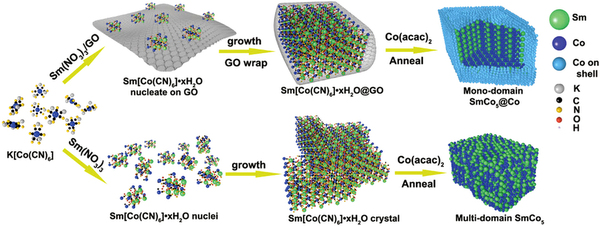
Schematic illustration of the synthetic strategy of SmCo5@Co magnet
The first authors of the two papers are Fei Liu, a 4th year Ph.D. candidate, and Ce Yang, a 5th year Ph.D. candidate in Prof. Hou’s group. These projects are supported by the National Basic Research Program of China, National Natural Science Foundation of China and Beijing Natural Science Foundation.