
-
[ March 22, 2014]
Stanford Professor Roland N. Horne lectures about the future of oil
-
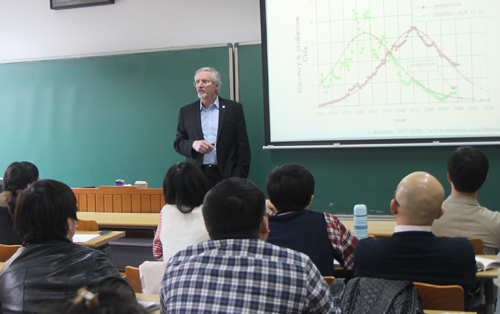 On March 19, invited by Associate Professor Bin Gong of the Department of Energy and Resources Engineering, Professor Roland N. Horne of Stanford University gave a lecture at Peking University about the future of oil. Many PKU students attended the lecture.
Roland N. Horne is the Thomas Davies Barrow Professor of Earth Sciences in the Department of Energy Resources Engineering at Stanford University, and Director of the Stanford Geothermal Program. He was formerly the Chairman of the Department of Petroleum Engineering at Stanford from 1995 to 2006, and elected a member of the U.S. National Academy of Engineering in 2002. He is best known for his work in well test interpretation, production optimization, and tracer analysis of fractured reservoirs.
According to Horne, over recent years, oil, the world’s primary source of transportation fuel, has reached a “pinch point” between supply and demand. Production from the discovered reservoirs has been relatively level but it’s harder to find new oil reserves. On the other hand, unconventional oils have played an increasingly important role in the world oil supply, particularly, shale oil and gas. Horne also talked about the growth of renewable energy, by analyzing the change of energy supply distribution among coal, gas, nuclear and renewables in the past decade, with prediction that the reliance on renewables will continue to grow.
In summary, Prof. Horne pointed out that while easy oil has been consumed, there are plenty of difficult oil, but demand will soon surpass supply. However, shale oil and gas changes everything and finally, renewables is in our future and our present.
The attending students showed great interest in Horne’s talk, and raised many questions such as the pros and cons of the use of the fracking technology and oil sand, the environmental impact of shale oil production and the potential of electric cars, and Prof. Horne gave detailed answers.