
-
[ March 26, 2014]
Xiaowei Zhan group achieves new advances in organic solar cells
-
 Recently, organic solar cells (OSCs) have attracted much attention due to their unique advantages such as low cost, flexibility, light weight, and large-area device fabrication. In 2014, Professor Xiaowei Zhan’s group in the Department of Materials Science and Engineering, College of Engineering has achieved new advances in OSCs and published 5 papers in Adv. Mater., Adv. Energy Mater. and Energy Environ. Sci.
In bilayer devices, each component of the bilayer can be separately optimized avoiding the problem of controlling the blend morphology. However, the reduced donor/acceptor interfacial area tends to give smaller short-circuit current density (JSC), leading to lower power conversion efficiencies (PCEs). Zhan group designed and synthesized a small molecule donor BDT-3T-CA with selected solubility and fabricated solution-processed layer-by-layer (LL) solar cells based on BDT-3T-CA/PC61BM acceptor. These devices exhibited PCE values as high as 4.16% with excellent fill factor (FF) values of up to 0.75, which is a record FF for solution-processed small-molecule solar cells (Adv. Energy Mater. 2014, 4, 1300626, highlighted by Materials Views China).
Furthermore, Zhan group fabricated layer-by-layer solution processed OSCs using polymer donor PBDTTT-C-T and PC61BM acceptor. Without solvent additives, the OSCs exhibited PCEs as high as 7.13%, which is much higher than that (4.49%) of its blend counterpart due to efficient vertical phase separation. The PCE of 7.13% is the highest reported for LL processed OSCs and among the highest reported for PC61BM based single-junction OSCs (Adv. Energy Mater., 2014, DOI:10.1002/aenm.201301349).
Zhan group used indene-C60 bisadduct (ICBA) as an electron-cascade acceptor in low-bandgap PTB7: PC71BM blend to fabricate ternary blend OSCs. The ternary blend devices with 15% ICBA content exhibited average PCE of 8.13%, higher than that (7.23%) of PTB7:PC71BM binary blend. Without any further device work (such as interlayer, invert structure and tandem cells), the ternary blend OSCs exhibited PCEs as high as 8.24%, which is the highest reported for ternary blend PSCs and ICBA-related OSCs (Energy Environ. Sci., 2014, DOI:10.1039/C3EE44202K).
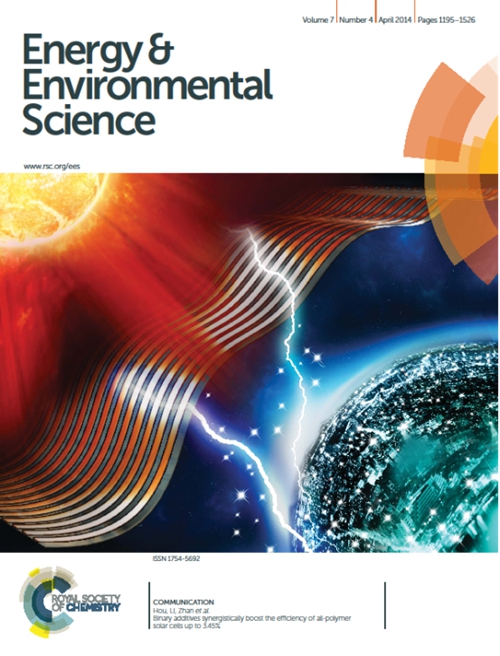
Fullerenes and their derivatives have been the dominant electron–acceptor materials in OSCs. However, the need remains to develop non-fullerene electron acceptors that will not only retain the favorable properties of fullerenes, but can also overcome their insufficiencies, such as their weak absorption in the visible spectral region, the limited spectral breadth, and limited energy-level variability. OSCs based on non-fullerene acceptors exhibit much lower PCEs than their fullerene counterparts. Development of high-performance non-fullerene acceptors is a challenging task. Zhan group fabricated all-polymer solar cells (all-PSCs) consisting of low-bandgap polymer donor PBDTTT-C-T and low-bandgap polymer acceptor PPDIDTT. Binary additives synergistically boosted the PCE of all-PSCs up to 3.45%, which is among the highest reported for all-PSCs (Energy Environ. Sci., 2014, 7, 1351-1356, Front Cover).
Furthermore, they designed and synthesized a novel 3D, star-shaped non-fullerene electron acceptor (S(TPA-PDI)) based on perylene diimide. Solution-processed OSCs based on PBDTTT-C-T: S(TPA-PDI) showed a PCE as high as 3.32%, which is among the highest values reported for solution-processed OSCs based on non-fullerene acceptors. (Adv. Mater., 2014, DOI: 10.1002/adma.201400525).
The research work was supported by the National Nature Science Foundation of China, the Ministry of Science and Technology of China and Chinese Academy of Sciences.