
-
[ June 17, 2014]
Professor Quan Li of Kent University gives invited lecture
-
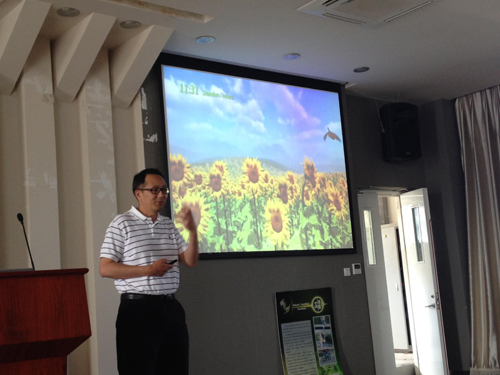 On June 12, invited by Professor Haifeng Yu of the Department of Materials Science and Engineering (MSE), College of Engineering, Professor Quan Li of Kent University visited MSE and gave a lecture entitled “Stimuli-Directing Liquid Crystalline Nanostructures: From Dynamic Photonics to Renewable Energy”. Dozens of teachers and students from MSE, Tsinghua University, Beihang University, University of Science and Technology Beijing, Beijing University of Chemical Engineering and Institute of Chemistry of Chinese Academy of Sciences attended the lecture.
Liquid crystals (LCs) represent a fascinating state of matter which combines order and mobility on a molecular and supermolecular level. The unique combination of order and mobility results in that LC is typically “soft” and responds easily to external stimuli. The responsive nature and diversity of LCs provide tremendous opportunities as well as challenges for insights in fundamental science, and open the door to various applications. Conventional nematic LCs have become the quintessential materials of LC displays. With the LC displays ubiquitous in our daily life and annual more than $100 billion market, the research and development of LCs are moving rapidly beyond display applications and evolving into entirely new and fascinating scientific frontiers. In his talk, Li focused on his recent research and development on stimuli-directing liquid crystalline nanostructures: from dynamic photonics to renewable solar energy.
Following the talk, Prof. Li met with many faculty members of MSE and exchanged thoughts on fields of common interests. Both parties expressed willingness of future cooperation.
In addition, Li shared with MSE graduate students about his research experience of nearly 30 years and offered many suggestions about English writing and paper publishing.
About Professor Quan Li
Quan Li is Director of the Chemical Synthesis and Advanced Materials Laboratory at the Liquid Crystal Institute, Kent State University, where he is also Adjunct Professor in the Chemical Physics Interdisciplinary Program. Over the past five years, he as Principal Investigator and Project Director has directed research projects supported by US Air Force Office of Scientific Research (AFOSR), US Air Force Research Laboratory (AFRL), US Department of Defense Multidisciplinary University Research Initiative (DoD MURI), US National Aeronautics and Space Administration (NASA), US Department of Energy (DOE), and US National Science Foundation (NSF) among other funding institutions. He has edited three Wiley books and one Springer book in the past four years and has written more than 20 book chapters and encyclopedia entries, along with many top journal publications and patents. He has got royalty from his four patents invented at Kent. Presently, his PhD students and postdoctoral fellows are actively involving in his funded projects. Li received his Ph.D. in Organic Chemistry from the Shanghai institute of Chinese Academy of Sciences (CAS), where he was promoted to a youngest Full Professor of Organic Chemistry and Medicinal Chemistry in February of 1998. He was a recipient of CAS One-Hundred Talents (BaiRenJiHua) in 1999. He was Alexander von Humboldt Fellow in Germany. He also won Kent State University Outstanding Research and Scholarship award.