-
[ May 09, 2014]
Xin-Rong Zhang group achieves new advances in microscale super-/near-critical fluid flow and heat transfer
-
Since the beginning of 2014, the Xin-Rong Zhang group from Department of Energy and Resources Engineering, College of Engineering has made a series of advances in microscale super-/near-critical fluid flow and heat transfer and published their results in world renowned journals of this field, such as Phys. Rev. E, Physica A, Int. J. Heat Mass Transfer, Appl. Therm. Eng., J. nanosci. Nanotech., etc.
Recently, the increasing demands of microscale synthesis, chemical extraction, energy conversion and micro-fluid control have brought series of new challenges to the scientific community. Super-/near-critical fluid is one kind of functional fluid, which performs dramatically properties change near the fluid critical region. During the critical transition, the compressibility diverges, while the thermal diffusivity tends to zero. Such abnormal fluid properties have been proved to be the dominant factors for super-/near-critical fluid microscale flows.
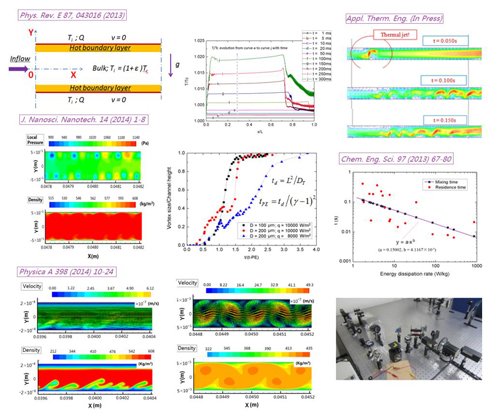
Indeed, as early in the mid-80s of the 20th century, fast thermal equilibrium of supercritical CO2 fluid in microgravity (in space experiment) has been found by the researchers from European Space Agency. And later in early 1990s, three independent groups recognized the basic mechanisms of such ‘abnormal’ thermodynamic process and termed it ‘Piston Effect’(as the Fourth heat transfer mechanism besides conduction, convection and radiation). Xin-Rong Zhang group first analytically explained the microscale super-/near-critical fluid thin hot boundary evolutions, by introducing the concept of Piston Effect. They acknowledged the detailed spatial scaling, time scaling, microfluid hot spot effects in microchannel flows of super-/near-critical flows and identified the micro-vortex type flow in such systems. The basic development and analysis have been published in Phys. Rev. E 87, 043016 (2013).
Later, Zhang group continued to develop models for open fluid flow systems of microscale under super-/near-critical conditions and found the basic thermodynamic profiles of the establishment of thin hot near boundary layers, so as to explain the detail thermal convective structures of the micro-vortex flow and heat transfer enhancement. Further, by introducing the stability analysis, the thermal Piston Effect and its relationship with time scaling results are discussed. The basic stability modes are identified to a new type of Kelvin-Helmholtz instability and Rayleigh-Taylor instability. The key point of this finding is that the stability lays will be modified when applied to microscale and for super-/near-critical fluid, the Piston Effect plays dominant role instead of gravity, therefore the current developments can be considered to be one extension of the K-H instability theory. The above results have been published in Physica A 398 (2014) 10-24.
Based on those findings, Zhang group designed new methods of micro-mixing and heat transfer enhancement method with super-/near-critical fluid inside microchannels. The feasibility and characteristics of such systems are also given and published in Chem. Eng. Sci. 97 (2013) 67-80, J. Nanosci. Nanotech. 14 (2014) 1-8, Appl. Therm. Eng. DOI: 10.1016/j.applthermaleng.2013.11.036. A brief summary of those studies can be found in Appl. Math. Mech (In Chinese). (March, 2014) 233-246. Zhang group has also achieved one Chinese Patent from this method (Method for mixing micro-channel based on supercutical fluid, Patent No. CN103007792 A).
Xin-Rong Zhang group is focused on novel thermal energy conversion systems and technologies, greenhouse gas utilization and management, waste heat utilization and energy-saving technologies and related thermodynamic, heat transfer and fluid flow topics.
The first author of the series papers is PhD candidate Lin Chen from Zhang group. This project is supported by National Science Foundation of China and the Beijing Key Laboratory for Solid Waste Utilization and Management.