
-
[ December 31, 2013]
Progress made in the research of order-oriented scheduling
-
Recently, research progress in order-oriented scheduling was made by Dr. Xiaoyun Xu, assistant professor in the Department of Industrial Engineering and Management, College of Engineering. His paper entitled “Customer Order Scheduling on Unrelated Parallel Machines to Minimize Total Completion Time” has been accepted by IEEE Transactions on Automation Science and Engineering, which is one of the leading journals in the area of production research. This paper presents the latest research advancement in order-oriented scheduling.
Make-to-Order is a milestone in modern manufacturing practice. In manufacturing environments where ERP system is implemented, Make-to-Order strategy demands a strong and intelligent link between sales order module and the production-planning module. This drives the strong need for the development for tools with customer order planning capability.
Seeking the optimal job assignment in order-oriented scheduling has been proved to be a very difficult task. It is not uncommon for modern manufacturing to have thousands of product types run on hundreds of machines with different capabilities. The existing research can only handle very small problem instances in the environment where all machines are assumed to be identical. This is, however, rarely the case in the practical applications and greatly limits the usefulness of the results.
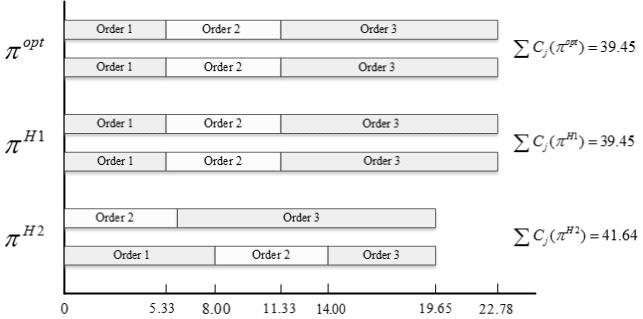
The Gantt Chart of SchedulingIn view of this difficulty, Dr. Xu and his colleagues extend the discussion to heterogeneous machine environment in which the processing time of each product type on each machines are independent. In the paper they prove several important optimality properties of the general problem as well as its special cases. For the first time, they prove that a non-trivial lower bound exists for the general problem and present its analytical form. Several algorithms are also proposed in their study and shown to be capable to solve problems of industrial scale.
To demonstrate the power of their solution, Dr. Xu and his colleagues apply their algorithms to a real-world manufacturing cases with 100 product types and 20 machines. The result shows a 43% reduction in lead time and outperforms all existing solutions.
The coauthors of the paper include Dr. Xu’s graduate students Ying Ma, Zihuan Zhou and Yaping Zhao. This research is partially supported by National High Technology Research and Development Program of China (863 Program) and National Science Foundation of China (NSFC).